Moon Phase Today
What phase is the Moon in today? Read the phase in seconds, see the eight phases with their lit share, and every new moon, quarter and full moon to 2027.
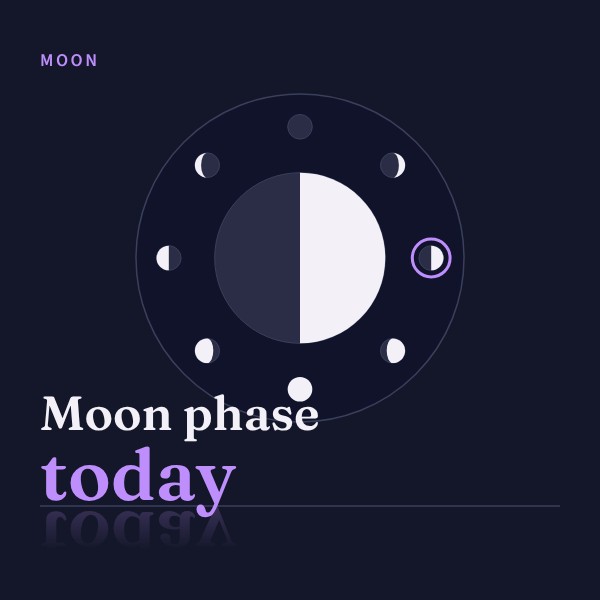
To know the Moon’s phase today, find today’s date in the monthly table below: it lists every new moon, first quarter, full moon and last quarter from November 2026 to October 2027, computed for Eastern Time. If today sits between two of those dates, the Moon is in one of the in-between phases (a crescent or a gibbous moon), and the second table tells you which one and how much of the disc is lit. You can also read the phase straight from the sky in a few seconds, by the shape and by the time of night you see it: that method is explained first.
This page doesn’t show a live, dated reading. It gives you the dates for the year and the way to read the Moon on any night.
How can you tell the moon phase tonight?
Two questions are enough: which side is lit, and is the lit part growing or shrinking?
- Lit on the right (in the US, the UK and anywhere in the Northern Hemisphere): the Moon is waxing, growing toward full. You’ll usually see it in the evening sky, after sunset.
- Lit on the left: the Moon is waning, shrinking toward new. It rises late and is mostly a late-night and morning sight.
- A thin curve is a crescent; half a disc is a quarter; more than half but not round is a gibbous moon; round is full.
An old memory trick: if the lit edge curves like the round side of a “D,” the Moon is waxing; if it curves like a “C,” it is waning. In the Southern Hemisphere it’s the other way around.
Look at which side is lit and how much: you have the phase.
What are the eight phases of the Moon?
The Moon goes through eight named phases in one cycle. The day counts below are days since the new moon; the lit share is the average percentage of the disc illuminated at that point, computed over all lunar cycles of 2026 and 2027.
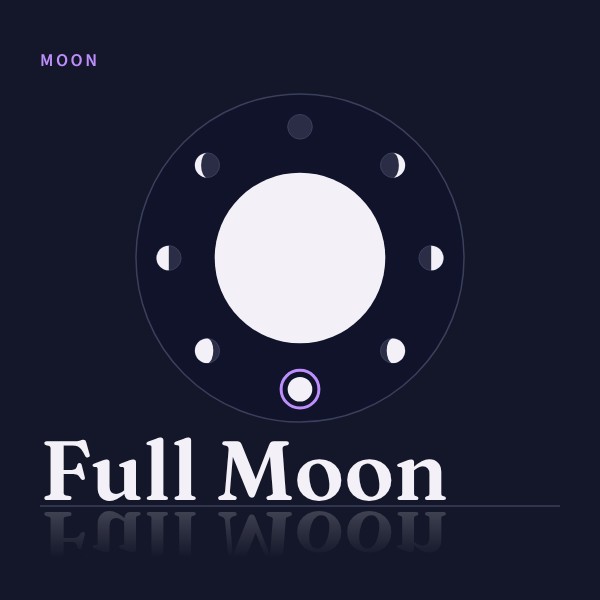
| Phase | Days since new moon | Lit share (mid-phase) | When you see it |
|---|---|---|---|
| New moon | 0 to 1 | about 1% | Not visible: it rises and sets with the Sun |
| Waxing crescent | 1 to 7 | about 16% at day 3.7 | Low in the west after sunset |
| First quarter | about 7 to 8.5 | about 51% at day 7.4 | Rises around midday, high at sunset, sets around midnight |
| Waxing gibbous | 8.5 to 14 | about 84% at day 11 | Afternoon to the small hours |
| Full moon | 14 to 15.5 | 100% at day 14.8 | Rises around sunset, up all night |
| Waning gibbous | 15.5 to 21 | about 85% at day 18.5 | Rises in the evening, visible into the morning |
| Last quarter | 21 to 23 | about 52% at day 22.1 | Rises around midnight, high at dawn |
| Waning crescent | 23 to the next new moon | about 14% at day 26 | Low in the east before sunrise |
The four “principal” phases (new, first quarter, full, last quarter) are precise moments; the four in between are stretches of several days.
Eight phases, one cycle of about 29.5 days: four exact moments and four stretches between them.
When are the new moons, quarters and full moons through 2027?
Here are the principal phases month by month, with the zodiac sign the Moon is in at that moment. Dates are in Eastern Time; in the UK a phase that falls late in the evening ET lands on the next day.
| Month | New moon | First quarter | Full moon | Last quarter |
|---|---|---|---|---|
| November 2026 | Nov 9 (Scorpio) | Nov 17 (Aquarius) | Nov 24 (Gemini) | Nov 1 (Leo) |
| December 2026 | Dec 8 (Sagittarius) | Dec 17 (Pisces) | Dec 23 (Cancer) | Dec 1 (Virgo), Dec 30 (Libra) |
| January 2027 | Jan 7 (Capricorn) | Jan 15 (Aries) | Jan 22 (Leo) | Jan 29 (Scorpio) |
| February 2027 | Feb 6 (Aquarius) | Feb 14 (Taurus) | Feb 20 (Virgo) | Feb 28 (Sagittarius) |
| March 2027 | Mar 8 (Pisces) | Mar 15 (Gemini) | Mar 22 (Libra) | Mar 29 (Capricorn) |
| April 2027 | Apr 6 (Aries) | Apr 13 (Cancer) | Apr 20 (Scorpio) | Apr 28 (Aquarius) |
| May 2027 | May 6 (Taurus) | May 13 (Leo) | May 20 (Scorpio) | May 28 (Pisces) |
| June 2027 | Jun 4 (Gemini) | Jun 11 (Virgo) | Jun 18 (Sagittarius) | Jun 27 (Aries) |
| July 2027 | Jul 3 (Cancer) | Jul 10 (Libra) | Jul 18 (Capricorn) | Jul 26 (Taurus) |
| August 2027 | Aug 2 (Leo), Aug 31 (Virgo) | Aug 9 (Scorpio) | Aug 17 (Aquarius) | Aug 24 (Gemini) |
| September 2027 | Sep 29 (Libra) | Sep 7 (Sagittarius) | Sep 15 (Pisces) | Sep 23 (Cancer) |
| October 2027 | Oct 29 (Scorpio) | Oct 7 (Capricorn) | Oct 15 (Aries) | Oct 22 (Cancer) |
August 2027 has two new moons, on the 2nd and the 31st, and December 2026 two last quarters. For the exact time of each full moon, its traditional name and the moonrise, see the full moon calendar.
To find today’s phase: locate the last principal phase before today and count the days since the new moon, then read the phase off the table above.
Find the last principal phase before today; the rest follows from the count of days.
Is the Moon full tonight?
The Moon looks full for about three nights around each full moon, but only one instant is the exact full moon. If tonight is within a day of a date in the “Full moon” column, the Moon will look full or very nearly so. The full moon calendar gives the minute and helps you pick the best night.
Within a day of the full moon date, it will look full to the eye.
Why does the Moon have phases?
The Sun always lights half of the Moon. As the Moon orbits the Earth, we see a changing share of that lit half: none of it at new moon, when the Moon sits between us and the Sun; all of it at full moon, when the Moon is on the far side of the Earth from the Sun (NASA Science, nofollow). The Earth’s shadow has nothing to do with the ordinary phases; it only matters during a lunar eclipse.
One full cycle, from new moon to new moon, lasts 29.53 days on average. Between 2020 and 2035, single cycles range from 29.28 to 29.81 days, because the Moon’s orbit is elliptical and its speed varies.
Phases are a matter of angle between the Sun, the Earth and the Moon.
What does each moon phase mean in tradition?
Spiritual and astrological traditions give each part of the cycle a theme, and many people use it as a monthly rhythm:
- New moon: beginnings. A time to set an intention or start something small.
- Waxing crescent and first quarter: growth and first decisions. Take the first concrete step.
- Waxing gibbous: refining. Adjust what you started.
- Full moon: culmination and clarity. Finish, celebrate, notice what’s become visible.
- Waning gibbous and last quarter: sharing and sorting. Keep what works, drop what doesn’t.
- Waning crescent: rest before the next cycle.
Astrologers add the Moon’s sign to the reading, which is why the table gives one for each phase. The Moon changes sign every two days or so, and that’s a large part of what makes each daily horoscope different. Readers who follow other cycles sometimes line them up: a new moon during a Mercury retrograde is traditionally read as a time to restart something old rather than launch something new.
Use the phases as a monthly rhythm: start at the new moon, finish at the full moon, rest at the end.
Moon phases and angel numbers
If a repeating number keeps catching your eye, some readers note the moon phase next to it. A 111 seen around the new moon reads naturally as a beginning; a 999 around the waning crescent as a cycle closing. The angel numbers guide has the meaning of each number if you’d like to try it.
Pair a number with the phase only if it helps you reflect; one reading at a time is fine.
How were these dates calculated?
All dates, signs, lit percentages and cycle lengths on this page come from PyEphem, an astronomical library, run on October 13, 2026 for the America/New_York time zone, with signs in the tropical zodiac. Day counts for the in-between phases follow the same thresholds across the site. The full moon times were cross-checked against the U.S. Naval Observatory’s tables.
The sky is computed; the meanings are tradition.
Key takeaways
- Lit on the right means waxing, lit on the left means waning (Northern Hemisphere).
- The cycle has eight phases over about 29.5 days: four exact moments and four stretches between them.
- The month table gives every new moon, quarter and full moon from November 2026 to October 2027.
- A full moon looks full for about three nights around its exact date.
- In tradition, the new moon is for starting, the full moon for finishing, the waning crescent for rest.
Once you know the trick, a glance at the sky tells you the phase.
Prepared by Vivian. Dates computed on October 13, 2026.