
Shooting stars
The Perseid meteor shower peaks on Friday, August 13, 2027. The International Meteor Organization puts the peak around 4 to 6 a.m. EDT, right at the end of the night in New York. Your best window is the night of August 12 to 13, after the Moon sets and before dawn.
Perseids peak
13
August 2027
around 4 to 6 a.m. EDT, per the IMO
9 to 11 a.m. BST in the UK
Moonset in New York
2:16
a.m. EDT, night of August 12 to 13
Moon 84% lit
dark sky until about 4:19 a.m.
Best night
Night of August 12 to 13, 2027
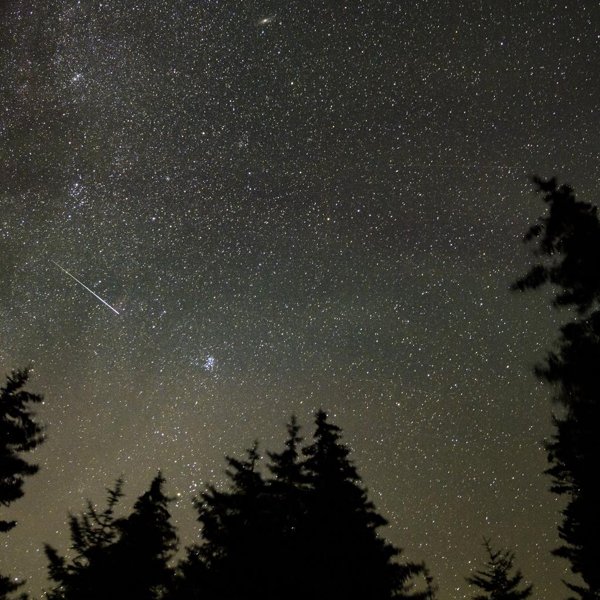
In New York, the Moon sets at 2:16 a.m. EDT and the sky stays fully dark until about 4:19 a.m., with the radiant near 59° high by 4 a.m. In London, the dark window runs from 1:12 to 3:14 a.m. BST. Image: NASA/Bill Ingalls, public domain.
When is the Perseid meteor shower in 2027?
The Perseids are active from July 17 to August 24, 2027, according to the Meteor Shower Calendar of the International Meteor Organization (IMO).
The IMO expects the maximum on Friday, August 13, 2027, between 08:00 and 10:00 UT, which is around 4 to 6 a.m. EDT. In New York, full darkness ends at about 4:19 a.m., so the peak window touches the very end of the night of August 12 to 13, as dawn begins. In the UK, it falls at 9 to 11 a.m. BST, in daylight, so the nights on either side count: August 12 to 13 first, then August 13 to 14.
The IMO gives a zenithal hourly rate (ZHR) of 110 or more. That figure describes a perfect sky, with no light at all and the radiant straight overhead. In real conditions you’ll see clearly fewer, because the Moon, city lights and a lower radiant cut into what your eyes can catch. Plan for the night of August 12 to 13, and keep the night after as a second chance.
The best night to watch from New York and London
In 2027, the Moon is waxing at the peak, midway between first quarter and full, as the IMO notes. From New York, it’s 84% lit on August 12 to 13 and 90% the night after, and while it’s up, its light washes out the faintest meteors.
In New York, the Moon sets at 2:16 a.m. EDT on the night of August 12 to 13, then at 3:16 a.m. on the night of August 13 to 14. The darkest window opens at moonset and closes when dawn starts, at about 4:19 and 4:21 a.m. It’s short, but it’s also when the radiant stands highest, close to 59° above the horizon at 4 a.m.
That’s about two hours of moonless sky on August 12 to 13, against one hour the night after. Be outside by 2 a.m. on Friday, August 13, and stay until the sky pales.
Night by night in New York
Eastern Daylight Time. The moonless window runs from moonset to the start of dawn.
| Night | Moonset | Moon lit | Dark sky, no Moon | Radiant at 4 AM |
|---|---|---|---|---|
| Aug 11 to 12 | 1:21 AM | 76% | 1:21 to 4:18 AM | 58° |
| Aug 12 to 13 | 2:16 AM | 84% | 2:16 to 4:19 AM | 59° |
| Aug 13 to 14 | 3:16 AM | 90% | 3:16 to 4:21 AM | 59° |
August 11 to 12 has the longest dark window, about three hours, but lower activity: a good warm-up night.
Night by night in London
British Summer Time. Full darkness is short in a British August, but the radiant climbs higher than in New York.
| Night | Moonset | Moon lit | Dark sky, no Moon | Radiant at 2 AM |
|---|---|---|---|---|
| Aug 11 to 12 | 12:16 AM | 74% | 12:16 to 3:11 AM | 49° |
| Aug 12 to 13 | 1:12 AM | 82% | 1:12 to 3:14 AM | 50° |
| Aug 13 to 14 | 2:18 AM | 89% | 2:18 to 3:18 AM | 50° |
In London, the two hours from 1:12 to 3:14 a.m. BST on August 12 to 13 are the pick of the week.
What about earlier in the evening?
In New York, the sky is fully dark from about 9:42 p.m. on August 12, but at 11 p.m. the radiant is only about 22° high. In London, darkness starts around 10:56 p.m., with the radiant near 31° at 11 p.m. Early meteors are fewer, and the Moon is still up. The second half of the night pays off better than the first.
Where the August shooting stars come from
The Perseids are grains of dust left by comet 109P/Swift-Tuttle, which goes around the Sun about once every 130 years. Each mid-August, Earth crosses that debris. The grains hit the atmosphere at high speed, heat up and leave a brief streak of light: a shooting star.
They all seem to come from one spot, the radiant, in the constellation Perseus, hence the name. Perseus sits low in the evening and climbs through the night, so the hours before dawn are richer.
The IMO points to something special about 2027: Earth passes through a part of the stream that Jupiter’s gravity has pulled closer to our orbit, which may raise activity by 10 to 20 percent. The shift grows by 2028, with, in the IMO’s words, a good chance of substantially higher rates then. 2027 is a good Perseid year, and 2028 may be better still.
How to watch the Perseids
You don’t need any equipment. Binoculars or a telescope narrow your view, while a meteor can appear anywhere: your eyes are the right tool.
- Get away from lights: a field, a beach, a backyard with no porch light.
- Lie down on a lounge chair or a blanket so you take in as much sky as you can.
- Don’t stare at the radiant: look a little to one side, toward a patch of dark sky, where streaks stand out better.
- Give your eyes 20 to 30 minutes to adjust, and keep your phone screen off.
- Bring a warm layer, even in August: at 3 a.m., the air cools fast.
Settle in before moonset so your eyes are ready when the dark window opens.
August 2027 in the sky around the Perseids
The month opens with the total solar eclipse of August 2, 2027, at new moon. The same lunar month runs on to the Perseids: every phase is in our moon calendar 2027.
The Moon then grows to the full moon of August 17, four days after the peak (see our full moon page), and the month’s other events are on our sky page. After August 13, the Moon stays up later each night, so the earlier nights are the better bet.
Wishes and the Tears of St. Lawrence: what tradition says
According to a popular tradition, you make a wish when you see a shooting star, as long as you say it before the streak fades.
The Perseids are also known as the “Tears of St. Lawrence,” a popular name tied to the saint’s feast day on August 10, a few days before the peak. These are customs, not forecasts.
Prepared by Vivian. Moon and darkness times computed for New York and London on November 13, 2026.